Our Blog

Dental Emergencies in Children

July 25th, 2018

Dental emergencies are bound to come up when you have young children. Drs. Carlisle and Fabre and our team want to you to be prepared in case you run into a difficult situation. Problems can vary, from minor gum irritation to knocked-out teeth. Take a look at the different possibilities and how you can handle them.

Teething

Depending on the age of your child, there are common things to watch for when it comes to his or her teeth. Starting from a young age, your son or daughter may experience teething pain. This starts at about four months and can last up to three years.

Teething may cause your little one to become irritable and more prone to drooling due to tender gums. This is very common in young children who are teething, and can be alleviated by giving them a cold teething ring or by rubbing their gums with your finger.

Teething pain is as normal as your child’s first set of teeth falling out. On the other hand, if a baby tooth is knocked out in a forceful accident, make sure you bring him or her into our Marrero office to check that other damage hasn’t occurred in the mouth. On occasion, permanent teeth may grow in before baby teeth have fallen out. This may not cause any discomfort, but Drs. Carlisle and Fabre should make sure the teeth are growing in properly. Catching teeth that are coming in incorrectly can prevent issues from arising in adulthood.

Gum Issues

If you’ve noticed your child’s gums bleeding often, this could result from a number of things. Bleeding gums may be an early sign of periodontal disease, which is caused by poor oral hygiene when it appears in children. Excessive gum bleeding can also occur when children brush their teeth too hard, or suffer an injury to their gum tissue.

If bleeding is continuous, rinse your child’s mouth with warm salt water and apply light pressure to the area. If you become concerned about the amount of blood, contact our Marrero office and we will schedule an appointment for your youngster as soon as possible.

Depending on what type of dental issue your child is experiencing, you should make sure to treat it quickly and properly. If you have questions or concerns about what you can do to help your son or daughter develop better oral hygiene habits, ask Drs. Carlisle and Fabre for tips during your next appointment.

Don’t forget: As a parent, you can provide the best education to your children on the importance of proper oral hygiene by setting a good example. 
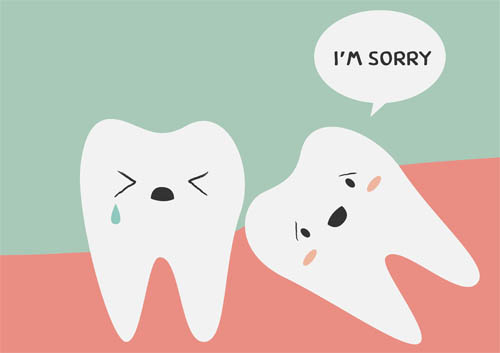
Warning Signs of Impacted Wisdom Teeth

July 18th, 2018

When your wisdom teeth start to emerge it can definitely be painful, but it can be even worse if your wisdom teeth become impacted. Impacted wisdom teeth are trying to erupt but are unable to do so because there is not sufficient room for them to emerge. This usually means that your wisdom teeth are painfully lodged in your jawbone.

While you may not see any real signs of the emerging wisdom teeth when they are impacted, what you can’t see can still definitely hurt you. Some of the indicators of impacted wisdom teeth are listed below.

  • Jaw Pain: Pain in the back of your jaw is a common indicator of impacted wisdom teeth. The pain often concentrates in the area around your gums.
  • Changes in the Mouth: You may notice some changes in your mouth when you have impacted wisdom teeth. Reddish gums, swelling in the jaw, bleeding gums, and bad breath can all be indicators that you are dealing with impacted wisdom teeth.
  • Headaches: If you suddenly start having headaches, especially at the same time as some of the other issues mentioned above, they may indicate impacted wisdom teeth.
  • Chewing Issues: Problems with chewing normally can indicate impacted wisdom teeth. If you are having trouble making the chewing motions because your mouth won’t quite open and close as easily as it used to, impacted wisdom teeth may be the culprit.

The Solution

If you are suffering from impacted wisdom teeth, the best solution is usually going to be removal. This is not a problem that will resolve naturally, and in fact, your pain and other symptoms may worsen as your wisdom teeth become increasingly impacted. At William J Carlisle III and Associates, Drs. Carlisle and Fabre can review the details of wisdom teeth removal surgery with you and help you determine if this is the best solution for your situation.

Three Must-Have Dental Treatments

July 11th, 2018

In dentistry, there are a wide variety of treatments, everything from elective procedures to those that are necessary and potentially lifesaving. So given the slew of treatment options, how do you choose what’s right for you? Our experts at William J Carlisle III and Associates have handpicked the three must-have procedures that we believe can benefit nearly every patient.

The first: A complete periodontal exam. If you are going to the dentist for scheduled cleanings, this exam should happen at least once a year. A periodontal exam is quick and relatively painless. The dentist or hygienist will carefully probe around each tooth to take measurements that show the health of the bone and its supporting tissue, all while looking for signs of any active infection. It has been suggested that there is a link between periodontal (gum) disease and the increased risk of some potentially fatal diseases such as heart disease, stroke, and diabetes. Signs of some diseases show up in the mouth sometimes before the patient is aware of changes in the body. Diabetes is one of these silent diseases. Many Americans are unaware that they have the disease until sudden and severe changes in the periodontal health of the teeth lead to a trip to the patient’s physician. And did you know that more adults lose teeth to periodontal disease than to cavities? A simple screening once a year can lead to saving your teeth.

The second treatment our team at William J Carlisle III and Associates recommends is a dental sealant; it’s not just for kids! Dental sealants provide a protective barrier from bacteria deep in the pits and grooves of the teeth where cavities often start. Sealants placed in childhood will often wear away in adulthood. Replacing a sealant as an adult can also help prevent decay in adulthood. This is a great cost-effective procedure for adults. Dental insurance will likely not cover sealants as an adult, but the cost of a sealant for prevention versus the cost of a filling is much less.

Our third must-have dental treatment is often the most fun: in-office whitening. Who doesn’t want an instantly dazzling smile? In-office whitening is one of the most dramatic and quick ways to brighten a smile. It will take a few years off your age in a two-hour period of time. Whitening is very safe and can give a patient newfound confidence to smile.

Happy Fourth of July

July 4th, 2018

Every year, Americans all over the world celebrate the birth of the country and its independence on the Fourth of July. There are countless ways that people celebrate and they range from community parades and large scale gatherings to concerts, fireworks displays, and smaller scale celebrations among family and friends. For some people, July 4th is synonymous with baseball, while for others it is all about the beach of barbecues. However you celebrate, you can be sure that red, white, and blue is visible everywhere throughout the area.

The Beginnings of Fourth of July Celebrations

Although it wasn't officially designated as a federal holiday until 1941, the actual tradition of celebrating Independence Day goes back to the time of the American Revolution (1775 – 1783). At the time of the American Revolution, representatives from the 13 colonies penned the resolution that ultimately declared their independence from Great Britain. The continental congress voted to adopt the Declaration of Independence on July 2nd of 1776. Two days later, Thomas Jefferson's famous document that is now known as the Declaration of Independence, was adopted by delegates representing the 13 colonies.

First States to Recognize the Fourth of July

In 1781, Massachusetts became the first state (or commonwealth) whose legislature resolved to designate July 4th as the date on which to celebrate the country's independence. Two years later, Boston became the first city to make an official designation to honor the country's birth with a holiday on July 4th. In that same year, North Carolina's governor, Alexander Martin, became the first governor to issue an official state order stipulating that July 4th was the day on which North Carolinians would celebrate the country's independence.

Fun Facts About the Fourth of July

  • The reason the stars on the original flag were arranged in a circle is because it was believed that would indicate that all of the colonies were equal.
  • Americans eat over 150 million hot dogs on July 4th.
  • Imports of fireworks each year totals over $211 million.
  • The first “official” Fourth of July party took place at the White House in 1801.
  • Benjamin Franklin didn't want the national bird to be the bald eagle. He believed that the turkey was better suited to the coveted distinction. John Adams and Thomas Jefferson disagreed with him, and he was outvoted, so the bald eagle became the official bird of the United States.

For many, the tradition is something entirely different. Along the coastal areas of the United States, people may haul out huge pots to have lobster or other types of seafood boils. Others may spend the day in the bleachers at a baseball game, or at a park, cooking a great traditional meal over an open fire. No matter how or where you celebrate, one thing is certain: all Americans celebrate July 4th as the birth and independence of our country.

Drs. Carlisle and Fabre and our team at William J Carlisle III and Associates wish you a safe and happy Fourth of July!