Our Blog

Treatment Options for TMD

November 11th, 2021

Temporomandibular dysfunction (TMD) refers to a diverse range of disorders that relate to muscular function in the jaw and face — the temporomandibular joint (TMJ). That could mean difficulty opening your mouth, pain in the jaw or face, or any sort of problem with the jaw joint.

TMD can be difficult to diagnose because of the varied causes. Whatever the case, an accurate diagnosis from Dr. Keith J. Fabre Jr. helps make treatment as successful as possible.

Most often, jaw problems will resolve themselves within several weeks or months. Surgeries like arthrocentesis, arthroscopy, and open-joint surgery should be a last resort. More conservative and reversible treatments should come first and are in fact the most critical step in the treatment of TMD.

Less invasive treatments like acupuncture and splints can be helpful, but that will depend on your particular case. It’s worth your while to speak with Dr. Keith J. Fabre Jr. at our Marrero office to learn about solutions that could work for you.

A combination of treatments will most often produce the greatest relief for TMJ patients. It’s a good idea to avoid activities that overuse the jaws, such as chewing gum or clenching your jaws.

You can be proactive in finding relief for TMD by trying the following remedies at home:

  • Eat soft food: When you eat soft and/or blended food, your jaw gets an opportunity to rest. Avoid chewy and crunchy food, and food that requires you to open your mouth wide, like apples or corn on the cob.
  • Apply moist heat: A hot water bottle wrapped in a moist towel can help reduce symptoms.
  • Apply ice: Applying an ice pack wrapped in a cloth or towel for no longer than 15 minutes may also reduce pain and promote healing.
  • Do jaw exercises: A physical therapist can help identify the exercises that will work for you. Jaw exercises have been shown to be an effective treatment method that can be performed at home.
  • Relaxation: Actively try to relax the muscles of the face and lips, and let your teeth come apart. Many find meditation, yoga, and slow, deep breathing to be helpful for reducing stress and tension.
  • Avoid wide yawns: Keep your fist under your jaw when you feel a yawn coming on, to keep your jaw from opening too widely.
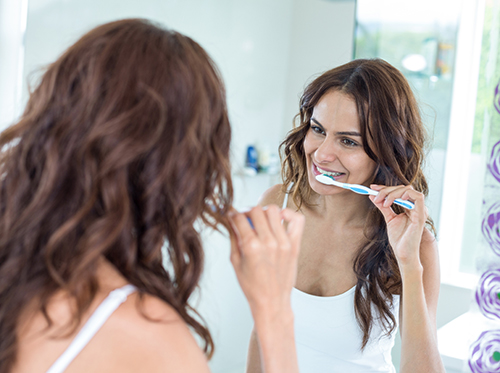
Ease up on your gums — don’t brush your teeth too hard!

October 28th, 2021

A lot of patients go at their teeth like they were sanding an old floor—that is to say, way too hard! Brushing too hard is probably the most common mistake patients make in their oral care routine, and it can be detrimental to the gums and teeth.

What can brushing too hard cause?

  • Receding gums
  • Bone loss around teeth
  • Loss of teeth
  • Tooth sensitivity, especially to hot and cold
  • Worn down enamel

Brushing too hard wears away at your gums, which can lead to the neck of the teeth being exposed. This part of the tooth isn't covered by hard enamel like the rest of the tooth and hence the soft inner layer, or dentin, is exposed. Dentin is very sensitive to hot and cold and much more susceptible to bacterial decay. Once the gums recede due to improper brushing, it’s usually irreversible.

How to brush your teeth properly

You know you're supposed to brush your teeth twice a day, so why not do it right? First and foremost, you should only ever brush with a soft bristled brush—not medium or hard—unless directed otherwise by Dr. Keith J. Fabre Jr.. Unless you have braces or specific oral health issues, brushing twice a day for two minutes is usually plenty.

The main purpose of brushing is to remove plaque from your teeth and gums. Plaque is actually soft and is a buildup of bacteria, saliva, and food debris. You really don't need to brush hard to remove it, just make sure you aim your toothbrush at the gum line (where plaque grows) and brush in small circular motions, never a back-and-forth motion.

It's also wise to hold your toothbrush gently. People tend to brush harder the tighter they hold their toothbrush.

Still have questions about proper tooth brushing technique or gum health? Ask any staff member or Dr. Keith J. Fabre Jr. during your next visit to our Marrero office; we'd be happy to help!

Take Your Pick!

October 21st, 2021

Before electric toothbrushes, before dental floss, before fluoride rinses, in fact, before recorded history, people who cared about their dental health had one primary tool—the toothpick. Ancient bronze toothpicks, bejeweled Renaissance picks, and the more humble modern wooden picks have been instrumental in promoting dental hygiene for centuries.

And, while that clean, simple design is still a good one, modern technology has found a way to build an even better toothpick. Today’s interdental picks not only dislodge food particles effectively, but now gum stimulation, cleaner orthodontic appliances, and fresher breath are available literally at our fingertips. Most important, these picks are just as effective as floss for removing plaque.

  • Wood? Still Good!

Today’s softer wooden picks come in several shapes designed to fit comfortably and snugly between the teeth. Using a gentle in-and-out motion, you can clean between your teeth as you remove plaque from the tooth surface. But that’s not the only benefit! As you move the wide end of the pick up and down between teeth and gums, you are actually stimulating your gum tissue as well.  They even come with mint flavoring to refresh your mouth as you clean. And, of course, wood and bamboo picks are biodegradable.

  • Plastic? Fantastic!

If you’d like something a little more yielding than wooden dental picks, you have options. Soft dental picks are available that use rubber “bristles” on a plastic stem to gently ease their way between teeth. The heads are available in different diameters to accommodate tight or wide spacing between the teeth. Straight or curved stems provide the accessibility you need. If you have latex allergies, be sure to choose a rubber product that is latex-free.

  • Interproximal Brushes? Here’s What the Buzz Is

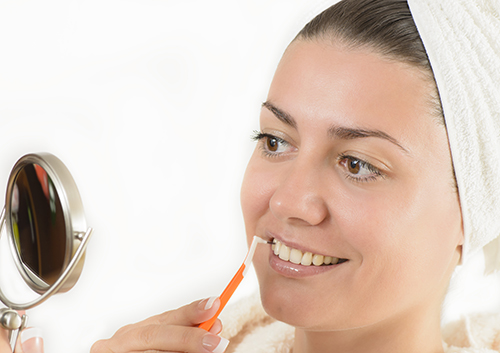
You might have missed these miniature brushes in the dental care aisle, but they are worth looking for. Interproximal brushes have small cone-shaped heads with nylon bristles for cleaning food particles and plaque from between the teeth. They are good for more than one use, and some are available with angled or bendable handles for hard-to-reach spots. They come in different diameters, from wide to extremely fine, to suit the spacing of your teeth. Interdental brushes are especially useful for braces wearers, who can use these clever tools to clean tight, tricky areas under wires and around brackets.

Even though bronze, bejeweled, or golden toothpicks aren’t available in the dental aisle of the local drugstore, increased efficiency and function are well worth the trade-off. If for any reason you have trouble flossing, or if you like the idea of massaging your gums as you clean your teeth, or if you wear braces, or if you want a burst of mint flavor—for any number of reasons today’s dental picks are worth a try. Talk to Dr. Keith J. Fabre Jr. at your next visit to our Marrero office, and we’ll be happy to give you some recommendations. 

What is a crown?

October 14th, 2021

If you have never had a crown before, you might be wondering why crown treatment is best, what the procedure involves, and which type of crown to choose. Let’s get down to the basics of crowns!

A crown is the best way to treat many dental conditions, either to strengthen and save the tooth or to improve its appearance. We might suggest a crown if you have any of the following conditions:

  • A filling that needs to be replaced, without enough tooth structure left to fill properly
  • A tooth that is fractured or broken, or so weak that it might fracture
  • A recent root canal
  • An implant
  • A bridge which needs a crown to serve as the base for attachment
  • A tooth that is discolored or irregularly shaped

On your first visit to our Marrero office, Dr. Keith J. Fabre Jr. will prepare the tooth that will be receiving a crown. A tooth might have to be built up if there isn’t enough of the original tooth left, or the top and sides of the tooth will be shaped down so that the crown fits smoothly and evenly with your other teeth. An impression will be made and sent to a dental lab so that a crown with the perfect fit for your tooth and mouth can be created. A temporary crown will be put in place to protect your tooth while the final crown is fabricated.

 The permanent crown is a cap which covers your tooth. It can be made of various materials, which all offer different advantages:

  • Metal Crowns—made of gold, platinum or base metal alloys, these are the longest lasting. Because of their metallic color, they are often chosen for back molars where they are less visible.
  • Porcelain Over Metal—because the color of the porcelain is matched to your natural teeth, these crowns look very realistic. Porcelain is more fragile than metal, so there is the possibility that they won’t be as durable.
  • Resin—less expensive than other options, but these crowns are more fragile and do not wear as well.
  • All Porcelain/All Ceramic—the most realistic looking option, especially for front teeth, and also suitable for anyone with a metal allergy. They are, again, not as strong as metal crowns, and can be subject to damage.
  • Stainless Steel—often used for baby teeth or as a temporary crown for adult teeth.

We’ll discuss your options and help you decide on the best type of crown for you. When the crown is finished at the dental lab, you will have one more visit where the crown will be secured in place. We will make sure your bite is comfortable and the color and appearance of the crown are satisfactory. We will also give you instructions for the next few days following the procedure, and can make adjustments if needed.

A crown is a perfect example of form and function working together: a crown maintains the beauty of your smile and preserves the health of your tooth. If you need a crown, we will be happy to talk to you about your best options for a strong, long-lasting, and natural smile.